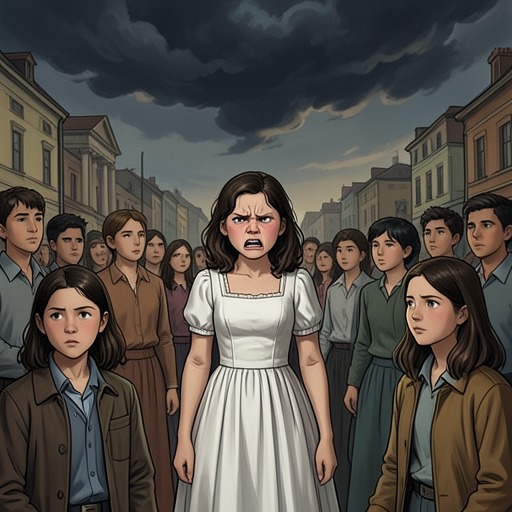
Chris Hargensen's Prom Revenge Plan
Stephen King Three Classic Novels Box Set: Carrie, 'Salem's Lot, the ShiningChris Hargensen's Prom Revenge Plan is the first clearly organized stage of the plot against Carrie White at the Spring Ball. It begins with Chris discovering that Tommy Ross and Carrie White are genuinely attending together and develops into an act of social retaliation: Chris treats the dance's seating arrangements, ballots, and ceremonial hierarchy as materials that can be turned against Carrie. The plan exposes how a public celebration becomes an instrument of private vengeance, with Chris's hostility supplying the purpose and William Nolan serving as the person she contacts to help make the attack possible.
Discovery and Immediate Outrage
Chris's scheme takes shape when Tina Blake secretly gives her access to the Spring Ball floor plan. Tina is uneasy about helping: she says she is not supposed to do so and fears that Norma Watson will reveal what happened if she returns. The warning establishes that Chris is trespassing into the organizational machinery of the dance, using another student's access to obtain information that is not meant for her. Once Tina leaves to buy a Coke, Chris becomes absorbed in the plan rather than merely glancing at it.
The floor plan, prepared by George Chizmar, gives Chris a complete map of the event. It marks the dance floor, the twin bandstands, the stage where the King and Queen will be crowned, and the card tables arranged around three sides of the room. Those tables are covered with crepe and ribbon and hold party favors, programs, and ballots. The scene therefore places Chris inside a carefully ordered ceremonial space: the dance is not an undefined gathering but a system of positions, visibility, and public recognition that can be manipulated.
Her decisive discovery is the seating assignment reading Tommy Ross and Carrie White. Chris traces the tables with her lacquered, spade-shaped fingernail, first along one side of the dance floor and then the other, until she finds them. The pairing makes her tremble with outrage. Her reaction is not uncertainty about whether the invitation will happen; it is anger that Tommy Ross and Carrie White believe they can proceed openly and escape the consequences. The plan's emotional engine is thus established as punitive certainty rather than spontaneous embarrassment.
Turning the Dance into a Weapon
Chris then searches the remaining papers on the scarred desk, including invoices for crepe paper and nails, lists of parents who lent card tables, petty-cash vouchers, and the bill for the prom tickets. The most important discovery is a sample King and Queen ballot. The actual ballot is supposed to remain secret until the candidates are announced over the school's intercom on Friday. Although the attending students will vote at the dance, nomination ballots have already circulated through homerooms, and the results are intended to be confidential. Chris's access to this material gives her knowledge of the event's hidden procedures as well as its visible layout.
The ceremony itself is already losing authority among the students. A growing movement wants to abolish the King and Queen tradition: some girls call it sexist, while some boys regard it as foolish and embarrassing. The text also suggests that this may be the last year the dance retains its formal, traditional shape. Chris nevertheless treats this possibly obsolete institution as the only year that matters. Her revenge depends on the very hierarchy that others are beginning to reject. She does not challenge the ritual; she wants to seize its public power and make its crown, seating, and audience serve her hostility.
When Chris studies the possible pairings, her judgment reveals the discriminatory social logic through which she imagines the contest. She dismisses George and Frieda Jason because Frieda Jason is Jewish, rejects another pairing because Myra opposes the ceremony, and evaluates Frank and Jessica according to athletic status, physical appearance, and popularity. These calculations show that the prom's supposed pageantry is governed by exclusion and ranking before Chris ever alters anything. Her plan is not an isolated corruption of an innocent ceremony; it exploits a social order already organized around who is considered acceptable, attractive, electable, or out of place.
The decisive ballot shows Tommy Ross paired with Sue Snell, but Sue Snell's name has been crossed out and Carrie White's written in. Chris recognizes the combination as powerful and absurdly provocative. Her laughter becomes strange and shuffling, and she covers her mouth to contain it. The alteration converts Carrie White's presence at the dance into a public spectacle before the evening has even begun. Chris sees the pairing as something capable of producing astonishment, ridicule, and social shock at once.
Secrecy, Surveillance, and Escalation
The plan depends on secrecy, but Chris repeatedly tests the limits of what she can take. When Tina Blake returns and warns that Norma Watson is coming, Chris tells her not to worry, replaces the papers, and leaves while still grinning. She pauses to raise a mocking hand toward Sue Snell, who is working on the mural. The gesture links the hidden theft of information to open antagonism: Chris conceals her activity from the adults or student organizers while making sure Sue can feel her contempt.
The physical arrangement of the scene reinforces the plan's stealth. Tina controls access to the office or desk, Norma Watson's absence creates a temporary opening, the floor plan and ballot provide privileged knowledge, and Chris must restore the papers before leaving. What appears to be casual school preparation is therefore staged as an infiltration. Chris uses the ordinary administrative documents of the dance as instruments of revenge, turning paperwork into a map of vulnerability.
Once outside, Chris fumbles a dime from her bag, drops it into the pay phone, and calls William Nolan. The call marks the transition from reconnaissance to mobilization. The evidence does not describe every word of the conversation, but it identifies the practical consequence of Chris's discovery: she seeks William Nolan rather than abandoning the idea. Her role is that of the instigator who identifies the target and initiates the next phase, while William Nolan and his friends become the means through which the imagined humiliation can be physically arranged.
Planning, Improvisation, and Narrative Function
An account from The Shadow Exploded questions how much planning went into the ruination of Carrie White, contrasting a carefully rehearsed design with an improvised and bumbling process. Its assessment favors the latter. It nevertheless identifies Christine Hargensen as the brains of the affair and suggests that she had only vague ideas about how to get at a girl like Carrie White. This distinction is central to the revenge plan: Chris possesses the sustained objective, the social intelligence to locate useful information, and the willingness to recruit William Nolan, but not necessarily a fully formed operational blueprint from the beginning.
The account further suspects that Chris suggested the trip to Irwin Henty's farm in North Chamberlain, imagining the result as a kind of warped poetic justice. That suggestion connects the prom plot to an earlier act of preparation and shows how Chris's revenge operates through delegation. She does not need to carry out every action herself. Instead, she converts resentment into a mission for William Nolan and his companions, giving violence a narrative of punishment that makes it appear, to her, deserved.
The plan's dramatic power lies in its collision of ceremony and sabotage. The King and Queen stage, the ballots, the tables, the decorations, and the seating chart promise a controlled public ritual. Chris reads those same structures as opportunities to expose and degrade Carrie White. Her outrage at Tommy Ross and Carrie White's pairing becomes an attempt to govern what the room will see, how the crowd will interpret it, and who will be made into the evening's object. The plan therefore prepares not simply an insult but a reversal of the dance's meaning: a ceremony of recognition is recast as a machine for humiliation.
Significance and Limits
Chris Hargensen's Prom Revenge Plan reveals a campaign whose objective is total destruction, even though its practical details emerge unevenly. Chris's motives are expressed through surveillance, contempt, social sorting, and recruitment rather than through a coherent public argument. She treats Carrie White's invitation as an intolerable breach of the hierarchy she believes should protect her own group, and she uses the prom's institutional rituals to enforce that hierarchy.
The plan also exposes the danger of a social world that mistakes tradition for control. The dance is already questioned as sexist, foolish, and soon to be obsolete, yet Chris finds in its fading rituals precisely the authority she needs. Her fixation on the one year that counts gives the event an intensified, almost terminal importance. By the time she calls William Nolan, the ordinary preparations for a school dance have become the infrastructure of revenge, and the gap between improvised cruelty and organized catastrophe has begun to close.